
Cavity Removal Path Planning for Dental Robotics
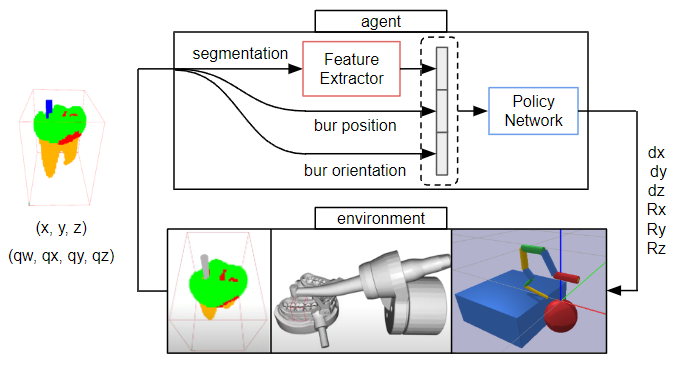
Cavity Removal Path Planning using Imitation Reinforcement Learning (CRPIR), a novel framework combining imitation learning (IL) and reinforcement learning (RL) to generate cut paths for cavity removal is presented. The generated cut paths enable cavity removal with minimal damage to healthy tissues while avoiding collisions with obstacles. The framework includes a cavity removal simulation environment integrated with dental anatomy segmentation data, facilitating sample-efficient RL training guided by IL. The IL policy is trained on demonstration cut paths generated by a classic cut path planning algorithm developed as part of this work.
- Motivation:
- Exploring the potential of robotics in dentistry, particularly for surgeries that require high precision and repetitive tasks.
- Addressing the challenges of cavity removal, one of the most prevalent and effort-intensive procedures, requiring minimally invasive removal of decayed tissue.
- Leveraging 3D medical image segmentation to identify cavities and healthy tissues, enabling downstream path planning for cavity removal that minimizes damage to healthy tissue and avoids collisions.
- Contributions:
- Developed a comprehensive dental anatomy segmentation dataset.
- Created a simulation environment for dental cavity removal tailored to reinforcement learning.
- Designed a classic path-planning algorithm for imitation learning in cavity removal.
- Conducted the first study on robotic automation of cavity removal using imitation and reinforcement learning.
- Skills:
- 3D Image Segmentation, Path Planning, Imitation Learning, Reinforcement Learning.
- Programming Language: Python.
- Tools: MONAI, 3D Slicer, OpenAI Gymnasium, Trimesh, Fexible Collision Library (FCL), Open3D, PyBullet.